

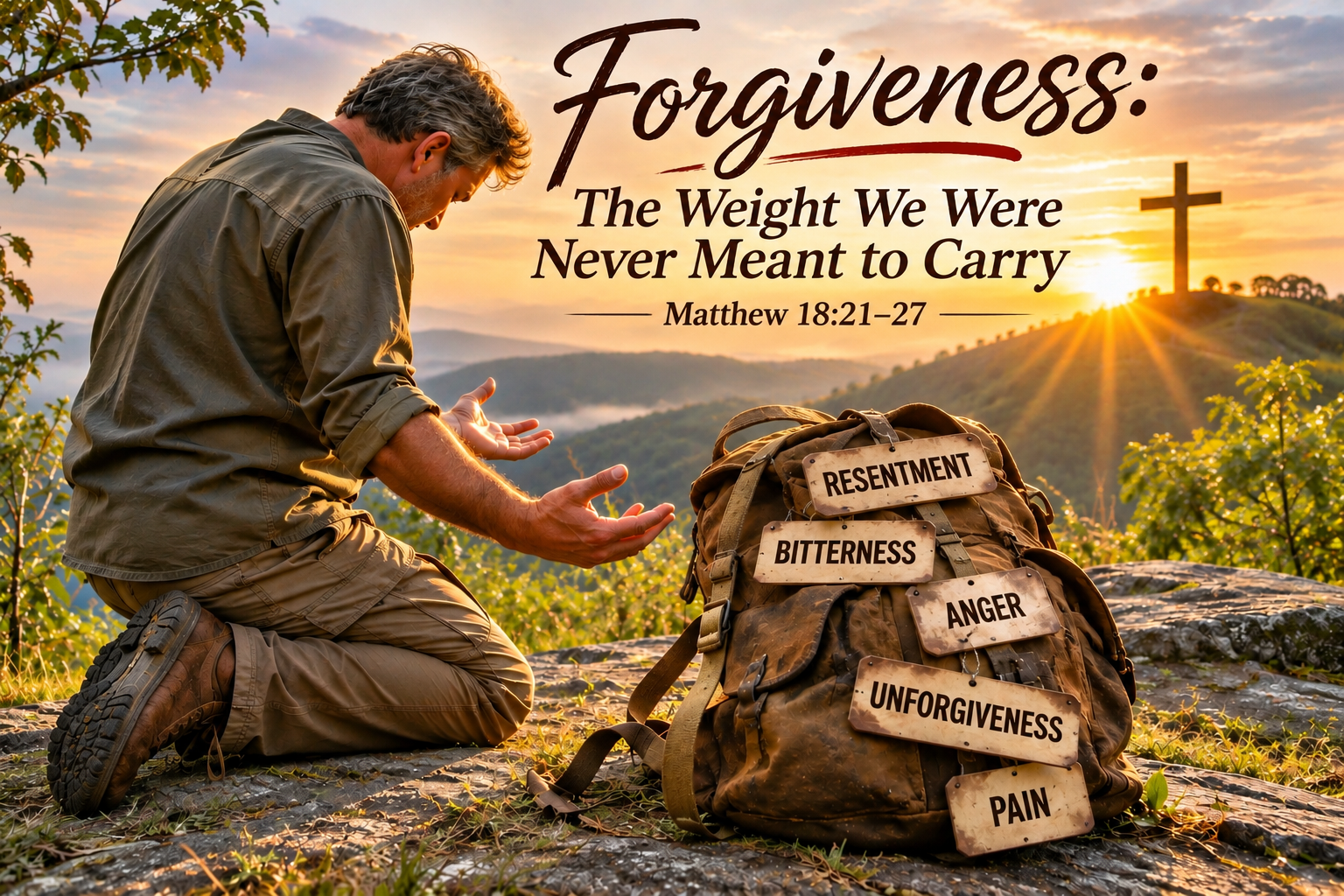
Scripture: Matthew 18:21–27 (NASB 1995)
The Burden We Carry
Have you ever considered how much of yesterday’s pain you may still be carrying today?
Perhaps someone betrayed your trust, spoke words that wounded you deeply, or committed an offense that changed the course of your life. The event itself may have happened years ago, or perhaps it was moments ago, yet the memory remains remarkably close.
Sometimes, all it takes is a familiar name, an unexpected encounter, or a passing thought to awaken feelings we believed had long since disappeared.
We remember the offense. We remember the pain. And sometimes, we remember every word.
Forgiveness is often presented as something simple. We are told to forgive, to move forward, and to let go. Yet for the person who has been deeply wounded, those words can seem painfully inadequate.
Forgiveness may be easy to speak about, but extraordinarily difficult to practice.
And perhaps the greatest struggle is not always what someone has done to us, but what we continue to carry because of it.
A Debt That Could Never Be Repaid
In Matthew 18, Peter approaches Jesus with a question concerning forgiveness. He asks how often he should forgive someone who sins against him, suggesting seven times.
Jesus’ response challenges Peter’s understanding of mercy.
He then tells a parable about a servant who owes his master an overwhelming debt—a debt so enormous that repayment is practically impossible.
Facing the consequences of his indebtedness, the servant falls before his master and pleads for patience.
But something extraordinary happens.
Rather than merely extending the repayment period, the master is moved with compassion and forgives the entire debt.
The servant receives something he could never have earned: mercy.
Consider the magnitude of that moment. Allow yourself you wrap your head as well as your heart around that for a moment.
The obligation that threatened his future was removed. The debt that he could never repay was forgiven.
He walked away owing nothing.
Yet, as Jesus continues the parable, this same servant encounters another man who owes him a comparatively insignificant amount.
Rather than extending the mercy he had just received, he demands repayment and has the man imprisoned.
He had experienced forgiveness but refused to extend it.
And therein lies the troubling condition of the human heart.
When Resentment Becomes a Prison
How often do we find ourselves holding tightly to the offenses of others?
We may rehearse conversations, revisit painful memories, or imagine the apology we believe we deserve.
Sometimes we wait for an acknowledgment that never comes.
Other times, we quietly believe that releasing our resentment would somehow diminish the seriousness of what happened.
But forgiveness does not declare the offense acceptable.
It does not suggest that the injury was insignificant, nor does it require us to restore trust where trust has been repeatedly violated.
Forgiveness does not change the wrong that was committed. It changes our relationship to the burden that wrong has left behind.
There is a profound difference between remembering an injury and allowing resentment to govern our lives.
The person who caused the offense may have moved forward, perhaps without ever recognizing the depth of the pain they caused. A wound too great for words.
Meanwhile, we may continue carrying the weight of an unpaid emotional debt.
And the longer we carry it, the more familiar that burden can become.
We may even begin to mistake our resentment for protection, believing that holding on to our anger somehow prevents us from being wounded again.
Yet resentment cannot undo yesterday. It cannot rewrite the offense.
And it cannot guarantee that justice will be served, at least on this side of Heaven.
What it can do is continue to occupy a place in our hearts, rent free, that God calls us to surrender to Him.
The Freedom Found in Grace
The parable of the unforgiving servant is ultimately about the extraordinary mercy of God and the responsibility of those who receive that mercy to extend it to others.
Jesus does not present forgiveness as an optional virtue.
He reveals that a heart transformed by divine mercy must take seriously the call to show mercy.
But there is also something deeply personal for us to consider.
When we forgive, we relinquish our insistence upon personally collecting the debt of an offense.
We entrust justice to God rather than allowing our desire for repayment to govern our hearts.
This does not mean that painful memories immediately disappear or that healing happens overnight.
For some, forgiveness may involve a long and difficult journey of prayer, reflection, wise counsel, and repeated surrender.
Yet through God’s grace, resentment need not have the final word.
We cannot always choose what others have done to us, but we can seek God’s help in determining whether their actions will continue to govern our hearts.
The freedom of forgiveness is not found in pretending the injury never happened.
It is found in no longer allowing that injury to define the entirety of our present and future.
A Question for the Heart
Perhaps today there is someone whose name still awakens anger within you.
Perhaps there is an offense you have carried for so long that you can scarcely imagine what life would feel like without it.
And perhaps the apology you have been waiting for will never come.
The question before us is not whether the pain was real. It is all too real.
Nor is it whether the wrongdoing mattered. It did.
The question is whether we will continue allowing that offense to occupy a place in our hearts that belongs to God’s grace.
We have received a mercy that we could never earn and a forgiveness that we could never purchase.
How, then, shall we respond to those who have wronged us?
Forgiveness may not change the person who wounded us, but through Christ, it can begin to change the heart that has carried the wound.
And, perhaps, that is where freedom begins.
A Closing Prayer
Heavenly Father,
You know the wounds we carry, including those we have hidden and locked away from others and sometimes even from ourselves.
You know the pain of betrayal, the weight of disappointment, and the bitterness that can take root when we struggle to forgive.
Lord, remind us of the immeasurable mercy You have extended to us through Your Son, Jesus Christ.
Teach us to forgive, not because the wrong committed against us was insignificant, but because Your grace is greater than the resentment we carry.
Give us wisdom to recognize the difference between forgiveness and reconciliation, courage to establish boundaries where necessary, and humility to entrust justice to Your hands, and not that of our own.
Where bitterness has taken root, cultivate compassion. Where resentment has hardened our hearts, soften them through Your love.
And where we have carried yesterday’s pain into today, help us begin to lay that burden before You.
May we become people who not only rejoice in receiving Your forgiveness but also reflect that forgiveness in the lives of others.
May we forgive, and forgive often, as you have done for those who seek it!
In the precious name of Jesus Christ,
Amen.
A Note About This Devotional
The heart, biblical theme, Scripture selections, and message of this devotional originate from the ministry of Shaped by the Son. Artificial intelligence (ChatGPT) was used as a writing, imaging, and editorial assistant to help organize, develop, and refine these thoughts for publication. The finished devotional has been personally reviewed and approved to ensure that it faithfully represents the intended message and biblical purpose of Shaped by the Son.


Leave a Reply